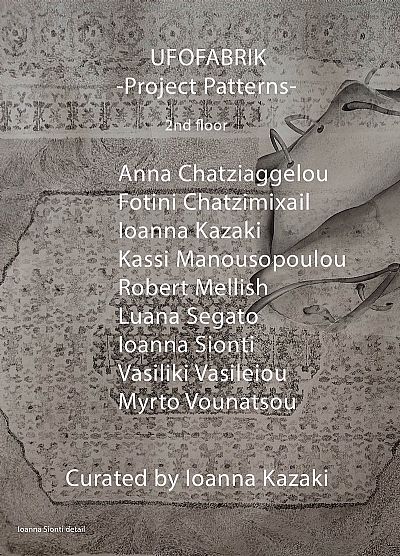
Patterns Ufofabrik | OpenArtLink 2025 Piraeus
Ufofabrik Contemporary Art Gallery
Curator: Ioanna Kazaki
Artists: Anna Chatziaggelou, Fotini Chatzimixail, Ioanna Kazaki, Kassiopi Manousopoulou, Ioanna Sionti, Vasiliki Vasileiou, Myrto Vounatsou.
Patterns are regularities of structure, shape and form of plants and animals. They are also genetically determined patterns that humans and intelligent organisms follow to make the appropriate decisions to survive in their environment.
Artificial intelligence technology uses categorized patterns to produce new realities. The life of people after the Agricultural Revolution is defined by unchanging regularities and enters into strictly conservative social frameworks.
“The formalist, Geometrically Decorative style, with the Neolithic era, enters a long period of unquestionable dominance, such as has never been achieved again in historical times by any tendency of the same formalism. This style dominates throughout the Bronze and Iron Ages and the ancient Near East and ancient Greece. That is, in a period of history that extends from 5000 to 500 BC. In comparison with this period of time, all subsequent styles seem short-lived. Even the traditional art of the modern era presents some features that are still related to the primitive geometric style.” Arnold Hauser Geometric repetitive patterns were for thousands of years a craft practice in the production of fabrics for domestic use and clothing.
They were inspired mainly by structures of nature such as spirals, meanders, waves, foams, by reflection symmetries, abstract symbolism and tessellations. The process, a predominantly female responsibility, was forced for some and expiatory for others. The thread for some women was the means to escape the labyrinth of dark thoughts resulting from self-sacrifice and limitation as a kind of Zen ritual. For other women, this repetitive, strict and conservative craft practice is a psychological compulsion. It was not until the twentieth century that the use of materials was redefined not only for the construction of crafts but also as a free creative artistic expression. Lenore Tawney, a Bauhaus graduate, was, in fact, the first to create three-dimensional works with threads that entered the arena of sculpture and installation. Her 1961 exhibition at the Staten Island Museum is considered to be the event that launched “Fiber Art” in the United States and helped this form of creativity move away from the idea of being a simple craft. Louise
Bourgeois used her youthful clothes to avoid being sacrificed to the moth, as she put it, which were modified and transformed into completely new forms. Redefining the use of materials, contemporary artists have incorporated artisanal materials and traditional techniques into their creative process, sometimes deconstructing patterns and sometimes constructing new compositions, exploring the meanings of this universal geometry.
The exhibition is presented at OpenArtLink 2025 | Piraeus Project, an initiative organised by CHEAPART and keramikos_23, aimed to unite international artists from diverse disciplines to explore innovation and creative exchange.
OpenArtLink 2025
Piraeus-Project
Athinon 8-12, 185 40, Piraeus 185 40
22 - 26 October, 2025
Opening: Wednesday, October 22, 2025
Organised by: CHEAPART, keramikos_23
Georg Georgakopoulos, Paolo Incarnato, Fotini Kapiris, Thalia Kerouli
https://www.openartlink.com